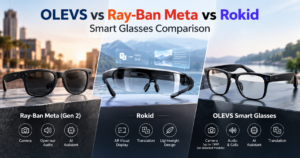
Ray-Ban Meta glasses have helped bring AI-powered eyewear into the mainstream. Combining a built-in camera, open-ear audio, hands-free photo and video capture, Meta AI, voice controls, and live translation in familiar Ray-Ban frames, they offer one of the most recognizable smart-glasses experiences available today.
But Ray-Ban Meta isn’t the only option.
Depending on what you actually want from smart glasses—POV recording, AI translation, hands-free photography, open-ear audio, object recognition, or simply a more accessible way to explore wearable AI—there are several alternatives worth considering.
Among them, OLEVS Smart Glasses offer different combinations of cameras, AI-assisted features, recording, translation, audio, and wireless connectivity. Rather than following a one-model-fits-all approach, OLEVS offers multiple designs for different users and use cases.
In this guide, we’ll look at some of the best Ray-Ban Meta alternatives, including the OLEVS WK106, OLEVS GS5, and OLEVS GS4, and explain where each option makes the most sense.
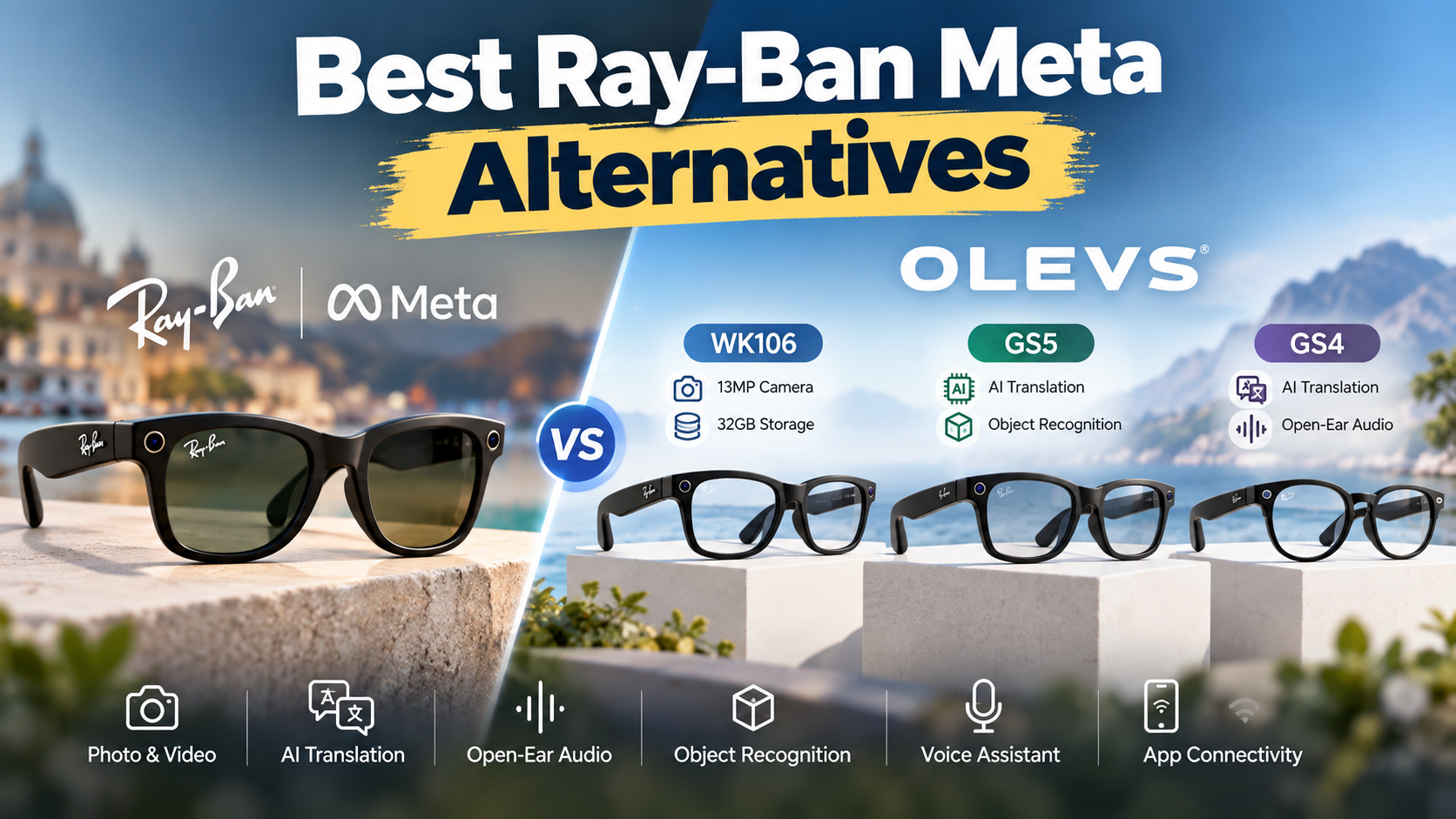
Quick Comparison: Ray-Ban Meta vs OLEVS Smart Glasses
| Feature | Ray-Ban Meta | OLEVS WK106 | OLEVS GS5 | OLEVS GS4 |
|---|---|---|---|---|
| Camera | 12MP ultra-wide | 13MP POV | 8MP | 8MP |
| Hands-Free Photo/Video | Yes | Yes | Yes | Yes |
| Built-in Storage | 32GB | 32GB | 4GB | 4GB |
| AI Assistant | Meta AI | Yes | Yes | Yes |
| AI Translation | Yes | Yes | Yes | Yes |
| AI Object Recognition | Meta AI visual capabilities | — | Yes | Yes |
| Open-Ear Audio | Yes | Built-in speaker | Yes | Supported |
| Wi-Fi File Transfer | Yes | App-based connectivity | Yes | Yes |
| Noise-Reducing Microphones | Multi-mic system | — | Dual ENC microphones | Dual ENC microphones |
| Water Resistance | IPX4 | — | IP65 | IP65 |
| Charging Case | Yes | — | 3600mAh case | — |
| Mobile App | Meta AI app | WAKEOK | Companion app | Companion app |
Specifications can vary by model, region, firmware, and software version. Always check the current product specifications before purchasing.
Why Look for a Ray-Ban Meta Alternative?
Ray-Ban Meta is compelling because it combines smart technology with the familiar styling and ecosystem of Ray-Ban and Meta.
Current Ray-Ban Meta models offer a 12MP ultra-wide camera, hands-free photo and video capture, open-ear speakers, voice interaction with Meta AI, live translation, 32GB of storage, Wi-Fi 6, Bluetooth 5.3, and integration with services such as WhatsApp, Messenger, Instagram, Spotify, and Apple Music. Newer models can capture video at up to 3K resolution.
Those capabilities make Ray-Ban Meta an attractive choice for users already invested in the Meta ecosystem.
However, not everyone needs the same ecosystem.
You might primarily want camera glasses for POV recording. Another person may care more about AI translation while traveling. Someone else might want open-ear audio and object recognition without making Ray-Ban styling or Meta integration the deciding factor.
That’s where alternatives become interesting.
Instead of asking simply, “What glasses are better than Ray-Ban Meta?”, a more useful question is:
Which smart glasses provide the features that matter most to me?
Here are three OLEVS options worth considering.
1. OLEVS WK106 — Best for POV Recording and Built-In Storage
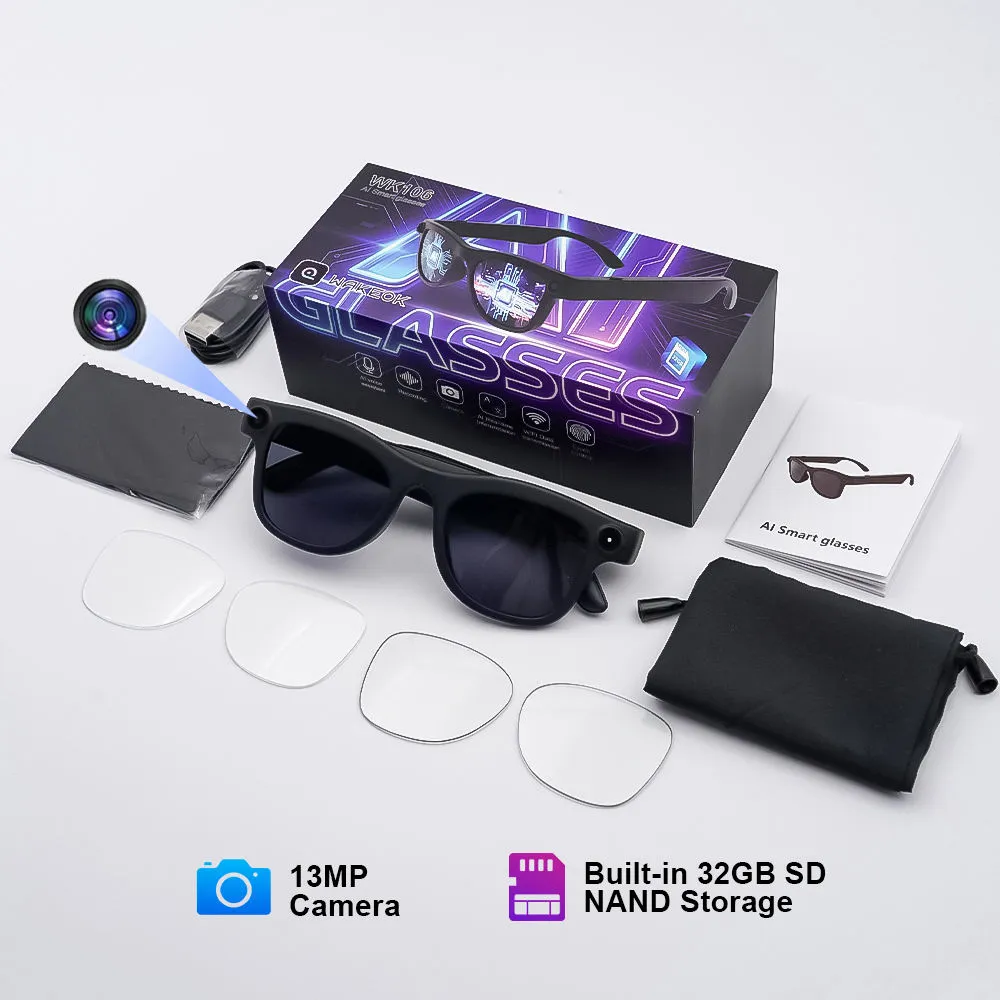
The OLEVS Smart Glasses WK106 are one of the closest OLEVS options for shoppers primarily interested in the camera and hands-free recording side of the Ray-Ban Meta experience.
The standout feature is its 13MP POV camera.
Rather than pulling out your smartphone whenever something interesting happens, the WK106 is designed to capture video from your natural point of view. This makes it particularly interesting for travel, casual content creation, walking tours, outdoor activities, and everyday moments where hands-free recording is useful.
It also includes 32GB of built-in storage, matching Ray-Ban Meta’s listed storage capacity, although the two products use different hardware and software ecosystems.
WK106 Key Features
- 13MP POV camera
- 32GB built-in storage
- Hands-free video recording
- AI real-time translation
- AI voice assistant
- Built-in speaker
- Music playback
- Phone call support
- WAKEOK app control
- 300mAh battery
- Magnetic charging
The combination of a 13MP camera and 32GB storage makes the WK106 particularly attractive for users who put recording ahead of advanced ecosystem integration.
WK106 vs Ray-Ban Meta
Ray-Ban Meta has several advantages. Its 12MP ultra-wide camera supports sophisticated capture modes and up to 3K video on current models, while Meta AI provides deep integration between the camera, voice assistant, Meta services, and supported third-party apps.
WK106 takes a different approach.
It gives you a 13MP POV camera, 32GB storage, AI translation and voice-assistant functionality in a simpler smart-glasses package.
That makes WK106 worth considering if your priorities are:
POV recording → storage → translation → everyday smart features
rather than having the full Meta ecosystem on your face.
Who Should Consider the WK106?
The WK106 is particularly suitable for:
- Travelers recording trips from a first-person perspective
- Casual content creators
- Walking and outdoor recording
- Users who want 32GB of internal storage
- People interested in AI translation
- Buyers exploring camera-equipped AI glasses outside the Meta ecosystem
Best for: POV video and built-in storage.
2. OLEVS GS5 — Best All-Round Ray-Ban Meta Alternative
The OLEVS Smart Glasses GS5 take a more balanced approach.
Instead of emphasizing camera resolution alone, the GS5 combines an 8MP camera, AI translation, AI voice interaction, AI object recognition, open-ear audio, Wi-Fi transfer, dual ENC microphones, IP65 protection, and a charging case.
This makes it arguably the most versatile OLEVS option of the three for someone looking for an everyday AI wearable.
GS5 Key Features
- 8MP camera
- Photo and video capture
- AI-powered real-time translation
- AI voice assistant
- AI object recognition
- Open-ear Bluetooth audio
- Wi-Fi photo, video, and audio transfer
- Dual ENC noise-reducing microphones
- Image stabilization
- IP65 dust, water, and sweat resistance
- Up to 12 hours of music playback
- 290mAh battery
- 3600mAh charging case
- Android and iOS companion-app support
These features give the GS5 significant overlap with the broader concept behind Ray-Ban Meta: glasses that can see, hear, record, communicate and provide AI-assisted functionality while leaving your hands free.
GS5 vs Ray-Ban Meta
Ray-Ban Meta has the stronger established ecosystem.
Meta AI can answer questions about what the wearer sees, provide assistance, handle reminders, support live translation and work with Meta services and a growing selection of compatible apps. Its 12MP camera also exceeds the GS5’s native 8MP camera resolution.
The GS5 counters with a different feature mix.
It offers AI object recognition and translation, open-ear audio, Wi-Fi media transfer, IP65 protection, dual ENC microphones, and a 3600mAh charging case.
For people who aren’t specifically looking for Meta integration, that combination makes GS5 an interesting alternative.
A Particularly Useful Feature: Charging Case
Battery management matters with wearable devices.
The GS5 includes a 3600mAh charging case, allowing the glasses to be recharged away from a wall outlet. That’s particularly useful for travelers, commuters and people using their glasses throughout the day.
Ray-Ban Meta also comes with a charging case, so shoppers who consider a portable charging system essential don’t have to give up the concept when considering the GS5.
Who Should Consider the GS5?
Consider GS5 if you want a balance of:
- Camera recording
- AI translation
- AI object recognition
- Voice interaction
- Open-ear audio
- Noise-reducing microphones
- Wireless file transfer
- Weather resistance
- Portable charging
Best for: travelers and everyday users looking for an all-round AI smart-glasses experience.
3. OLEVS GS4 — Best for AI Translation and Everyday Smart Features
The OLEVS Smart Glasses GS4 are another strong option for people whose priorities extend beyond recording.
Like the GS5, the GS4 uses an 8MP camera and combines it with AI-assisted translation, voice interaction, object recognition, Wi-Fi transfer, dual ENC microphones and image stabilization.
GS4 Key Features
- 8MP camera
- Photo capture
- Video recording
- Audio recording
- AI-powered translation
- AI voice assistant
- Voice wake-up
- AI object recognition
- Wi-Fi file transfer
- Dual ENC microphones
- Electronic image stabilization
- IP65 dust and water resistance
- Magnetic charging
- Up to 12 hours of music playback
- Android and iOS compatibility
The GS4 is therefore less about replacing one specific Ray-Ban Meta feature and more about providing a broad collection of AI + camera + audio capabilities in one wearable.
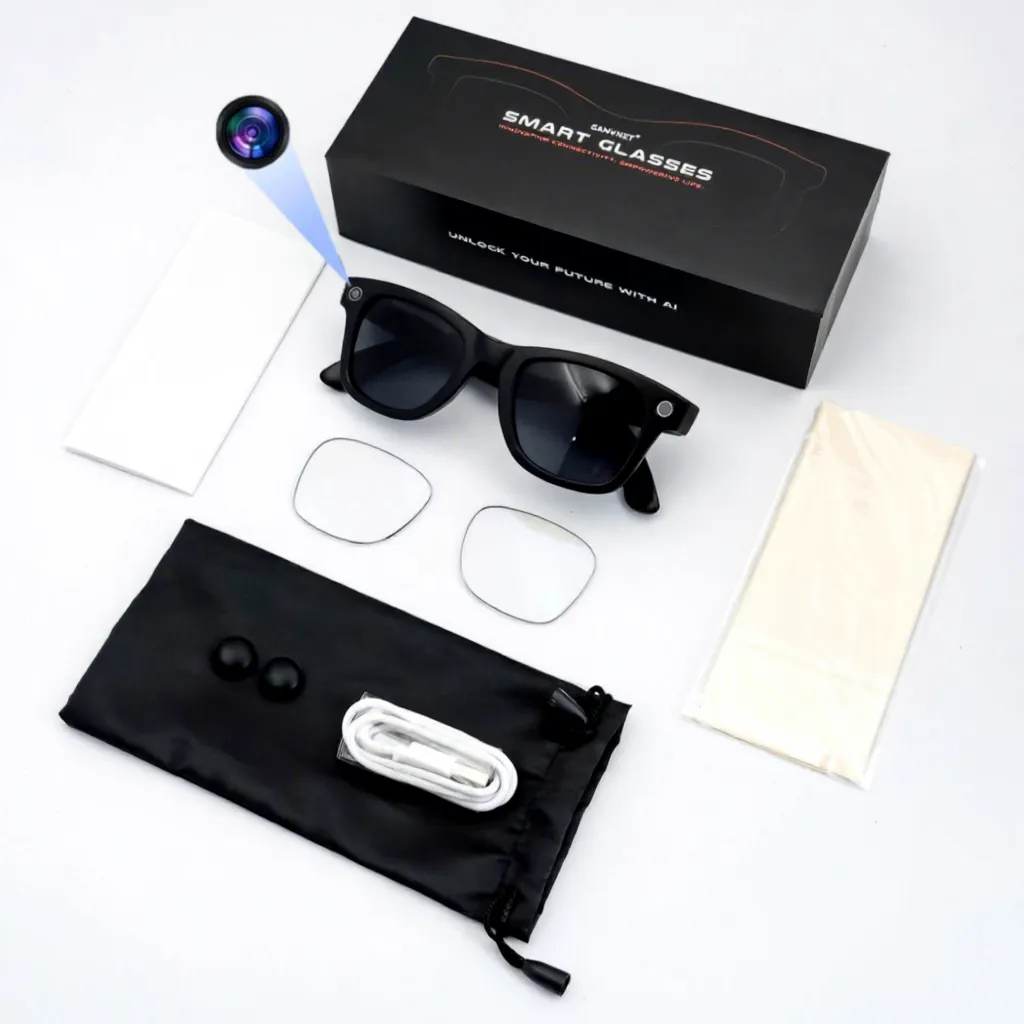
GS4 vs Ray-Ban Meta
For camera performance and ecosystem integration, Ray-Ban Meta has clear advantages on paper. Its current 12MP ultra-wide camera supports up to 3K video, and Meta AI connects directly with the glasses’ visual input and supported services.
GS4 instead combines its 8MP camera with features including real-time AI translation, object recognition, voice assistance, Wi-Fi file transfer, dual ENC microphones, electronic stabilization and IP65 protection.
That difference is important.
Someone primarily interested in Instagram, WhatsApp and Meta AI integration will probably find Ray-Ban Meta’s ecosystem more compelling.
Someone primarily interested in experimenting with AI translation, object recognition and hands-free recording may find the GS4 feature combination more relevant to their needs.
Who Should Consider the GS4?
GS4 is worth considering for:
- International travelers
- Users interested in AI translation
- People who want object-recognition features
- Hands-free photo and video recording
- Outdoor and active use
- Users who want Android and iOS compatibility
Best for: AI translation and general-purpose smart features.
Ray-Ban Meta vs OLEVS: Which Features Matter Most?
There isn’t one universal winner because these glasses emphasize different things.
Choose Ray-Ban Meta if you prioritize the Meta ecosystem
Ray-Ban Meta makes the most sense if your priorities include:
- Meta AI
- Ray-Ban frame styling
- Instagram, Messenger and WhatsApp integration
- 12MP ultra-wide camera
- Up to 3K video on current models
- Mature open-ear audio
- Hands-free social content creation
- A deeply integrated hardware/software ecosystem
Ray-Ban Meta is more than a camera placed inside a pair of glasses. The integration between Meta AI, the camera, microphones, speakers, apps and cloud-based services is an important part of its appeal.
Choose OLEVS WK106 if POV recording is your priority
WK106 is the OLEVS model to examine first if you want:
- 13MP POV camera
- 32GB internal storage
- AI translation
- AI voice assistance
- Hands-free recording
It’s a particularly interesting option for travel and first-person content capture.
Choose OLEVS GS5 if you want the most balanced feature set
GS5 combines:
- Camera
- AI translation
- Object recognition
- Open-ear audio
- Dual ENC microphones
- Wi-Fi transfer
- IP65 protection
- Charging case
For someone exploring smart glasses as an everyday wearable rather than specifically buying into Meta’s ecosystem, GS5 deserves consideration.
Choose OLEVS GS4 if AI translation is a major priority
GS4 brings together:
- AI translation
- Object recognition
- Voice assistant
- Camera recording
- Wi-Fi transfer
- Image stabilization
- IP65 protection
It can be particularly useful for travel and other situations where AI-assisted features matter more than social-media integration.
What About Live Translation?
Translation is one of the most interesting areas of overlap between these smart glasses.
Ray-Ban Meta supports live translation, allowing translations to be heard through the glasses while transcripts can be viewed through the companion app.
OLEVS WK106, OLEVS GS5, and OLEVS GS4 also list AI translation functionality, making translation one of the key features to consider when comparing these products.
However, buyers shouldn’t assume that every product handles translation identically.
Language availability, processing, app requirements, internet connectivity, latency and user experience can differ between platforms. If translation is your main reason for buying smart glasses, check the currently supported languages and app requirements for the specific model before purchasing.
What About Cameras?
Camera specifications deserve similar caution.
A larger megapixel number does not automatically mean better photos or videos.
Ray-Ban Meta’s current camera system uses a 12MP ultra-wide sensor and supports features including 3K video, adjustable stabilization and multiple capture modes.
OLEVS WK106 uses a 13MP POV camera with 32GB of internal storage, while OLEVS GS4 and OLEVS GS5 use native 8MP cameras and add AI-assisted functionality and stabilization features.
Real-world results also depend on image processing, optics, lighting, stabilization, video compression and software.
So choose based on the whole camera system and intended use, not megapixels alone.
Are OLEVS Smart Glasses AR Glasses?
No—and neither are the standard Ray-Ban Meta AI glasses discussed in this comparison.
These products should not be confused with AR glasses that project a digital interface directly into the wearer’s field of view.
The models covered here are primarily AI-enabled camera and audio smart glasses. Their smart functions rely on cameras, microphones, speakers, mobile apps, wireless connectivity and AI processing rather than a conventional augmented-reality display built into the lens.
This distinction matters if you’re expecting floating screens, navigation arrows or virtual monitors directly in front of your eyes.
Which Ray-Ban Meta Alternative Should You Choose?
Think about your primary use case before comparing individual specifications.
If you want the strongest integration with Meta AI, social platforms and the Ray-Ban ecosystem, Ray-Ban Meta remains the obvious product to examine.
If you’re looking outside that ecosystem, the OLEVS lineup provides several different approaches.
For POV recording:
Choose OLEVS WK106 for its 13MP POV camera and 32GB built-in storage.
For an all-round AI wearable:
Consider OLEVS GS5 for its combination of camera, AI translation, object recognition, open-ear audio, Wi-Fi transfer, IP65 protection and charging case.
For translation and AI-assisted everyday use:
Consider OLEVS GS4, which combines an 8MP camera with AI translation, object recognition, voice assistance, stabilization and wireless media transfer.
There is no reason to choose smart glasses solely because one specification is larger than another. The better approach is to identify the two or three features you’ll actually use and choose accordingly.
Explore More AI Smart Glasses
Smart glasses are evolving quickly. Cameras are improving, AI assistants are becoming more capable, translation is becoming more practical, and wearable devices are increasingly able to handle tasks that once required pulling out a smartphone.
Ray-Ban Meta is an important part of that evolution—but it isn’t the only way to experience AI-powered eyewear.
OLEVS offers smart glasses designed around different combinations of camera recording, AI translation, voice assistance, object recognition, open-ear audio and everyday wearable convenience.
You can explore the complete OLEVS Smart Glasses collection to compare additional models and find the combination of features that fits your needs.
Featured OLEVS Alternatives
OLEVS Smart Glasses WK106
13MP POV Camera • 32GB Storage • AI Translation • AI Voice Assistant
View OLEVS WK106
OLEVS Smart Glasses GS5
8MP Camera • AI Translation • Object Recognition • Open-Ear Audio • Charging Case
View OLEVS GS5
OLEVS Smart Glasses GS4
8MP Camera • AI Translation • Object Recognition • Wi-Fi Transfer • IP65
View OLEVS GS4
Frequently Asked Questions
1. What is the best alternative to Ray-Ban Meta smart glasses?
It depends on what you want from your glasses. OLEVS WK106 is worth considering for POV recording and 32GB storage, GS5 provides a broad combination of camera, AI translation, open-ear audio and object recognition, while GS4 focuses on AI-assisted features, translation and recording.
2. Are there smart glasses similar to Ray-Ban Meta?
Yes. Several smart glasses combine cameras, audio, voice assistance and AI features. OLEVS WK106, GS5 and GS4 overlap with different aspects of the Ray-Ban Meta experience, although their hardware, apps, AI systems and ecosystems are different.
3. Which OLEVS smart glasses are best for recording?
The WK106 is particularly recording-focused, featuring a 13MP POV camera and 32GB of built-in storage. GS4 and GS5 also support photo, video and audio recording with 8MP cameras.
4. Which OLEVS smart glasses are best for travel?
GS5 and GS4 are particularly interesting for travelers because they combine AI translation with cameras and AI-assisted functionality. WK106 is another option for travelers who prioritize POV recording and internal storage.
5. Do OLEVS smart glasses support AI translation?
Yes. WK106, GS4 and GS5 list AI translation among their smart features. Translation capabilities and supported languages may depend on the model, companion app, connectivity and software version.
6. Do OLEVS smart glasses have a display in the lenses?
The WK106, GS4 and GS5 models discussed here are not positioned as AR-display glasses. They use cameras, speakers, microphones, apps and AI-assisted functionality rather than projecting a conventional AR interface onto the lenses.
7. Are OLEVS smart glasses compatible with Android and iPhone?
GS4 and GS5 list Android and iOS compatibility through their companion mobile apps. For WK106 and other models, check the current product page and WAKEOK app requirements before purchasing.
8. Are OLEVS smart glasses waterproof?
GS4 and GS5 are rated IP65 for protection against dust, sweat and water exposure. This does not mean they should be submerged. Water-resistance specifications vary by model.
9. Is a higher-megapixel camera automatically better?
No. Megapixels are only one part of camera performance. Optics, sensor quality, image processing, stabilization, lighting and video encoding also affect the final result. Compare complete camera capabilities rather than megapixel numbers alone.
10. Are Ray-Ban Meta glasses worth it?
Ray-Ban Meta can make sense for buyers who value Ray-Ban styling, Meta AI, integrated camera and audio capabilities, and compatibility with services such as Instagram, Messenger and WhatsApp. Buyers primarily interested in particular features such as POV recording, AI translation or object recognition may also want to compare alternatives before deciding.